

Everything Was Ready. Until It Wasn’t.
What the field reveals when internal alignment is mistaken for a Regenerative Agriculture transition at scale

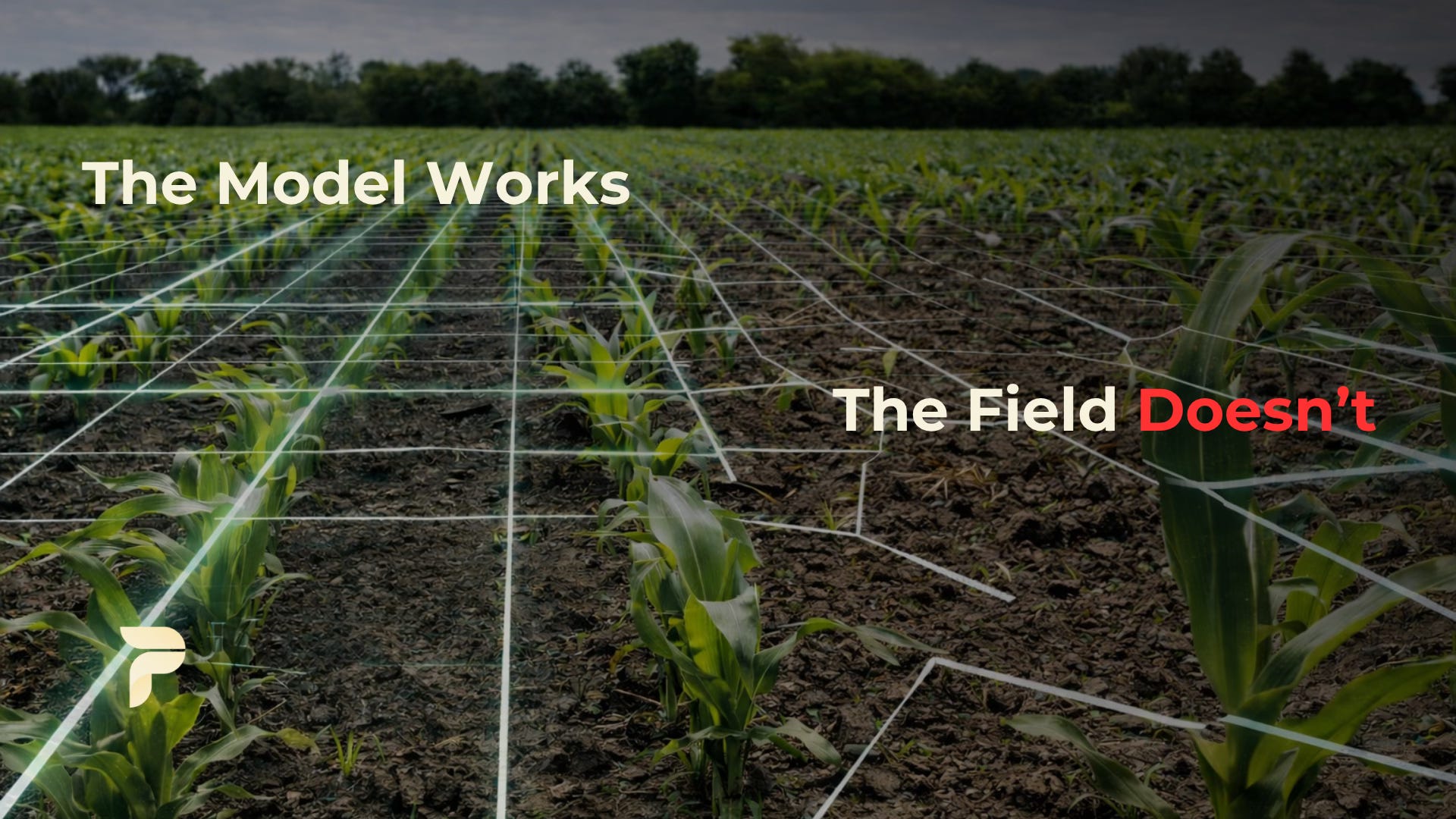
A few months ago, a company asked me to help them enter the Brazilian market.
Their view of the situation: the hard work was done. Offer defined. Investment approved. Go-to-market outlined. They needed someone on the ground to connect with customers and activate relationships.
What they needed, in their words, was execution.
There is a specific kind of confidence that comes with that framing. The internal battles have been fought. Trade-offs made. Resources allocated. The system, everyone assumes, is ready. What’s left is to make it move.
The first question was always speed.
When Complexity Gets Mistaken for Depth
Before we moved into the field, something in the early conversations caught my attention.
At one point, almost in passing, someone described the offer as “not simple to explain.” Said it without hesitation. As if difficulty to explain was a signal of how much had been built.
It wasn’t.
As we spent time unpacking what was actually being offered, the complexity started to feel different. Not deep. Unfocused.
Each attempt to describe the offer landed somewhere else. Sometimes it was an MRV solution. Sometimes carbon. Then consulting. Then regenerative transition support. Then certification. Then trading.
None of those perspectives were wrong. But they didn’t converge.
So we kept returning to the same question: what is the offer, exactly? Not in strategy terms. In farmer terms. What would be said to a producer. What problem it solves. Where the value actually comes from.
Those conversations never resolved into one answer. They produced variations. No single narrative held when placed next to the others. No stable center.
When Farmers Ask the Real Questions
We moved into the field. Conversations with farmers and potential buyers.
These are usually treated as validation exercises. Confirm that what was designed internally resonates externally.
That’s not what happened.
Farmers weren’t reacting to the solution design. They were trying to understand what it meant for their reality. That shift changed everything.
They weren’t asking about methodology. They were asking about continuity. Who buys what they produce. Under what conditions. For how long. Whether participation in this system could actually be sustained over time.
Those are not skeptical questions. They are basic questions. And they didn’t have solid answers.
No defined offtake structure. No concrete demand signal that translated intention into something commercially real. What existed, at that point, was closer to a possibility than a system.
When Capital Gets Asked to Compensate
That realization shifted focus toward funding.
If demand was still forming, maybe capital could absorb the early uncertainty. Buy time for the system to develop and stabilize.
Funding had been secured. That provided confidence at the start. But the structure of capital matters more than its existence.
It was designed to enable initiation, not to support a transition. It assumed relatively quick validation. But the environment required the opposite: patience and the acceptance that outcomes in agriculture don’t materialize on internal timelines.
The system was built for one scenario and operating in another.
When Timelines Don’t Match the Ground
Expectations were anchored in short cycles. Early results. Visible traction. The kind of signals that make sense inside an organization with performance reviews to answer to.
Agriculture doesn’t work that way.
Trust with farmers isn’t built in weeks. Adoption doesn’t happen in a single conversation. Outcomes linked to soil or productivity follow biological cycles that cannot be compressed for a quarterly deadline.
This tension wasn’t visible at the start. It became increasingly relevant as everything else accumulated.
The Pattern
Individually, none of these elements looked fatal. Each felt like something to refine.
But they weren’t isolated. They were connected. And together they formed a pattern.
The offer didn’t align with what farmers needed in practice. The commercial structure wasn’t anchored in real demand. The capital available didn’t match the time required. The expected timelines didn’t match how change actually happens on the ground.
At a certain point, these can’t be treated as execution gaps. They point to something that was never fully formed to begin with.
A system still forming behaves differently from one that is fully defined. It can generate activity. It can produce early signals that look promising. But it can’t hold when exposed to the full conditions it was built for.
By the time this becomes visible, most of the work is already in motion. Decisions made, resources committed, expectations set. Revisiting the design at that stage feels like stepping back, not forward. So the tendency is to keep moving. Adjust where possible. Compensate for what doesn’t fit.
Sometimes that holds. For a while.
What usually follows isn’t a clean failure. It’s a gradual loss of coherence. Decisions take longer. Momentum weakens. Progress becomes harder to sustain.
From the outside, it still looks like something moving. From the inside, it feels increasingly difficult to maintain.
Why This Pattern Keeps Repeating
The context changes. The terminology shifts. The actors differ. But the dynamic follows a familiar arc.
A solution gets defined with strong internal alignment. A pilot launches under conditions flexible enough to allow early movement. Early signals get interpreted as confirmation. And then comes the assumption that what has been started can be scaled.
That’s where the test changes.
Scaling removes the flexibility that made the early stages possible. It introduces a consistency requirement that can’t rely on exceptions. It forces alignment between elements that were never fully aligned to begin with.
Farmers operate on seasonal risk and cash flow. Companies navigate internal performance cycles. Capital follows its own return structure and time horizons. Ecosystems evolve according to biological processes that don’t respond to any of these.
Each is coherent in isolation. But coherence in isolation isn’t enough.
What holds a system together isn’t the strength of each part individually. It’s how those parts connect under pressure.
When that connection is assumed rather than designed, it holds only under limited conditions. The moment conditions change, the system reveals itself — not as intended, but as it actually operates.
What Revealed Itself in Brazil
The realization didn’t come as a single moment.
It came through conversations that didn’t fully land. Through explanations that shifted depending on the angle. Through expectations that never quite connected with the conditions they were meant to operate within.
There was no clear breaking point. Only a growing recognition that what had seemed ready was still taking shape.
That’s the harder situation to navigate. Not because it fails visibly. But because it keeps moving, creating the impression of progress while gradually revealing its own limits.
Every system gets tested eventually. Not in theory. In practice.
And when it is, it doesn’t respond based on intention. It responds based on structure. It reveals what it actually is.
Some systems don’t fail when they scale.
They reveal that they were never fully there.
If alignment is assumed, scale will expose it.
Where in your current work are you moving forward on something that still hasn’t fully taken shape?
Designing a regenerative sourcing program or deploying capital into agricultural transition? Let’s map which curve you’re on, before the program launches.